
BY ANDREW FARRIS
In the United States, school pride is often portrayed and valued as an essential component to the high school experience. Pep assemblies are routine at Truman, and students are highly encouraged to participate in the loud chants and traditions that celebrate the character of our school and its student body: The Patriots. As one could imagine, design is an essential component to the development of a unique school identity; even so, many high schools across the country seem to represent themselves by taking the symbols of famous teams and organizations to use as their own. Until about five or six years ago, Truman was no exception.
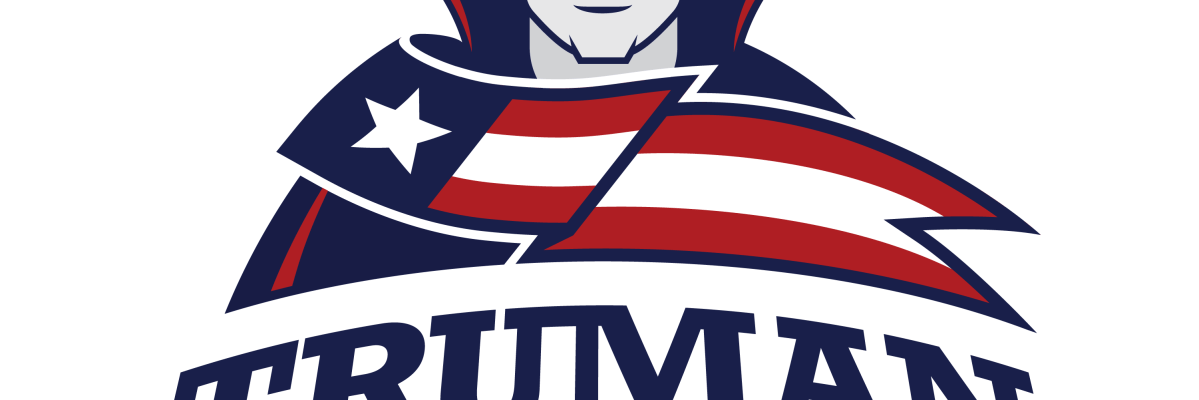
Truman’s current logo, designed by the ISD’s director of communication alongside a consultant in graphic design, depicts a Revolutionary War era patriot with a flag draped over his chest. The logo’s original design successfully sets it apart from both local schools and the identities of organizations everywhere.
In contrast, Truman’s previous logo had shared nearly identical features with the logo of the New England Patriots. Which had a gray face with shaded features, wearing a blue tricorn hat, looking to the right, followed by two trailing red stripes. The old logo was displayed for many years, so what prompted the change?
“The school and district wanted a logo that represented Truman uniquely,” claims Truman Principal Ronda Scott. “… I like the new logo. I’m not a New England Patriots Fan, so I like that the logo is unique to our school.¨
Even though Truman has since changed its logo, some nearby schools still display recognizable copies of professional team designs. In fact, just within Truman’s group of local athletic competitors, there are at least four schools that actively copy logos from major teams: Lee’s Summit High School uses an identical copy of the University of Missouri’s tiger logo with an “LS” printed behind it, Grain Valley High School displays a reversed and recolored version of the Philadelphia Eagles logo, Lee’s Summit West High School uses a simplified version of the Tennessee Titans logo and Blue Springs High School uses a near exact copy of the K-State logo.
“I remember when the K-State Wildcat was introduced as our mascot,” says Truman visual arts teacher and Blue Springs High School alumni Jeff Bertoncin. “As a teenager, I thought it was a lame choice… I understand that high schools usually don’t have the resources to come up with their own unique logo… I feel like, if schools tried, they could find an art teacher or a talented parent that could create something unique, but it also would have to be agreed upon by a number of people.”
Taking that last point into consideration, it would be risky to pay money to an artist to create a logo in the chance that it’s denied by the school. There would be much less to lose if an existing logo with minor adjustments was rejected instead of a paid commission from a professional designer.
“I know from experience that if even a small number of people were unhappy, then the new logo would be turned down,” says Bertoncin. “High schools wouldn’t be able to pay what a designer’s time would be worth.” For many schools, there’s not enough room in the budget to establish a creative identity.
With the financial obstacles that high schools face in mind, is it acceptable for them to use existing team logos as their own? Perhaps it could be justified as inspiration, taking an existing idea and giving it new life in a different environment.
“Inspiration would be imitating the style of a logo,” Bertoncin states. “For instance, making a cardinal or blue jay aggressive and stylized like the Philadelphia Eagle. Theft is using the eagle, even if colors are changed and small changes are made…. from a designer’s standpoint, it’s plagiarism. Someone spent time working on that logo and was paid for their efforts. A school or professional team probably paid handsomely for the logo, and with dozens of different versions, it makes theirs less recognizable, and definitely less unique. It becomes something seen as clipart instead of a team’s identity. But I also understand that high schools are strapped for resources…”
It’s an important responsibility for schools to teach students not to plagiarize, not only to preserve academic and personal integrity, but also to warn students about the legal repercussions that they might face by doing so in the real world. When it comes to high schools plagiarizing existing logos, any justifiable leeway given in part by their tough budgetary position would be considered null and void by the legal system. Professional teams have the grounds to sue, but they choose not to. At least anymore.
In the past, there have been several instances of colleges and professional sports organizations suing high schools over the illegal use of their team logos, but many of them seemed to backfire, hurting their reputation. After all, a rich and powerful business trying to make a profit by taking money away from a small school’s budget wouldn’t present the best image. As described in an article by the Los Angeles Times, the MLB had previously attempted to sue children’s sports over the illegal use of their logos almost thirty years ago, but they found little success and lots of criticism. As explained by Bertoncin, “They had a right to do so, but the overwhelmingly negative public response made them pull back on their efforts.”
For many high schools across the country, budgetary limitations make plagiarism the most accessible option when it comes to establishing both their logo and identity. While some schools like Truman have decided to invest in developing a unique school image, countless others have continued to copy existing team logos, and many will likely continue to do so in the future without the threat of legal repercussions.
Principal Scott says, “I don’t think it was bad to have it, but it was time for a change, and I like the logo we have now.”
Categories: News

 THS Media